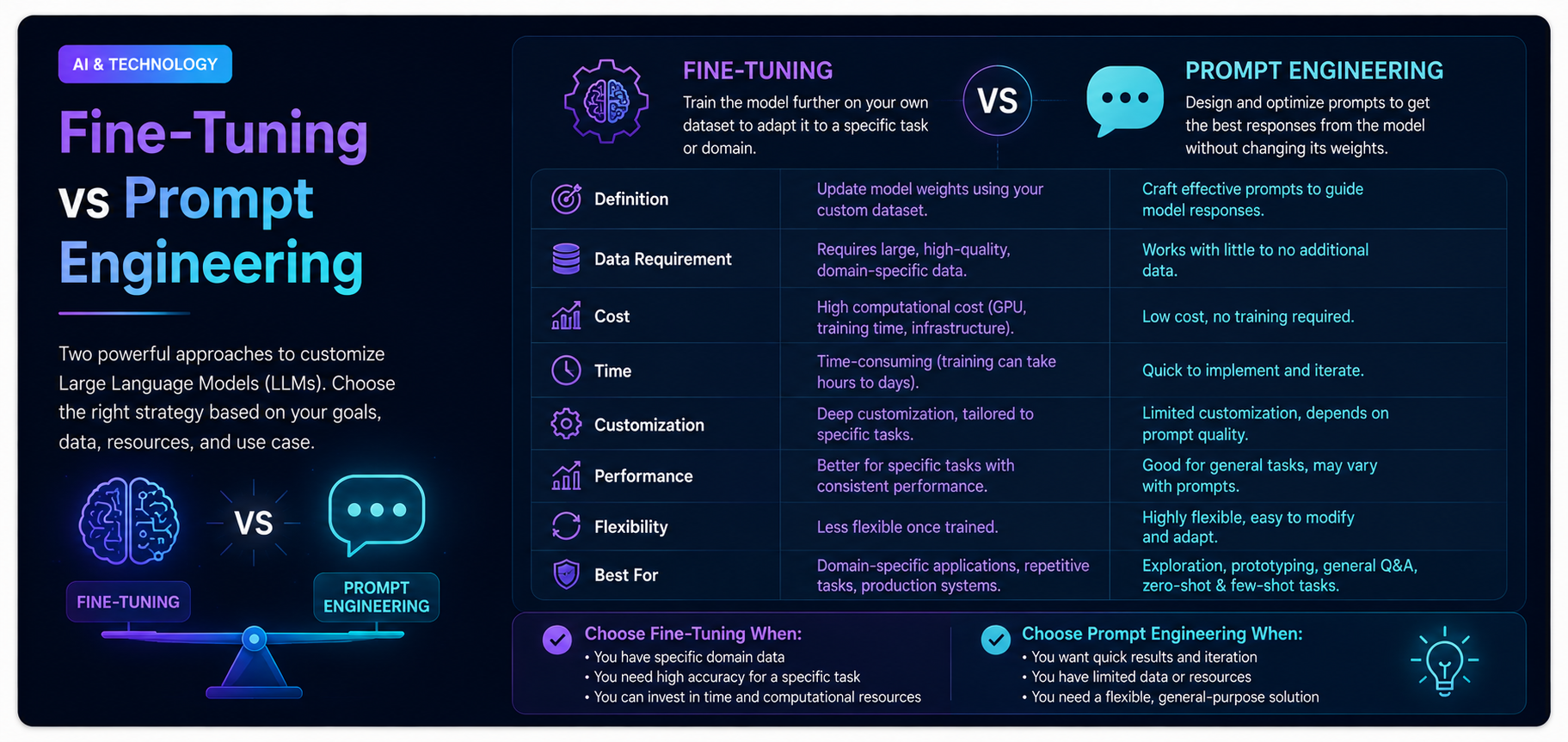
As Large Language Models (LLMs) become increasingly powerful, two popular approaches for improving their performance are Fine-Tuning and Prompt Engineering. Fine-tuning involves retraining a pre-trained model on domain-specific data to achieve highly customized and accurate results for specialized tasks. In contrast, prompt engineering focuses on designing effective prompts that guide the model to generate better responses without modifying its underlying parameters. While fine-tuning offers greater accuracy and personalization for production-grade applications, prompt engineering is faster, more cost-effective, and ideal for rapid prototyping and general-purpose AI solutions. Understanding the strengths and trade-offs of both techniques helps developers choose the most suitable approach based on project requirements, available resources, and desired outcomes.